Project: 100 Westerns: Part Ten: Slow West; West of the Pecos; Jonah Hex; Dead Man

Dear gunfighters,

Four more movies have been compiled in Project: 100 Westerns!

While in past write-ups I’ve claimed that I don’t really have a methodology of the movie picks, I realized that’s a bit of a lie. While I don’t normally select based on subgenre or the talent in front of or behind the camera, I definitely try to divvy my choices up by decade. I like to get a cross sample of the different eras of Hollywood, and Westerns are a fantastic time capsule for this.

In this group I definitely slanted toward newer releases… Let’s see how it went!


#36. Slow West (2015)
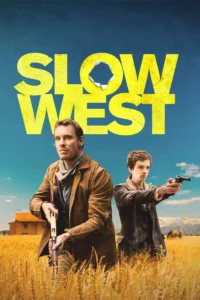
In 1870, a lovesick boy and a bounty hunter travel through Colorado to find the boy’s crush, but the bounty hunter has other plans…

It’s sort of wild this movie has been out for ten years, as it still feels somewhat new to me. Starring Kodi Smit-McPhee and Michael Fassbender, this wandering low-budget Western with a revisionist slant is methodical in its gait. Not a whole lot happens plot-wise, but it somehow feels full and complete nonetheless.

A lot of the drive behind the endeavor is fueled by the interactions between the naive but determined Jay and the wise but jaded Silas. This is hardly the first Western to team up two disparate souls but the reluctant camaraderie between the two provide the plot with enough juice to reach the end goal. The central tension of Silas tracking down Jay’s object of affection, Rose Ross (Caren Pistorius), while the younger man tries to wrangle his emotions is a pretty damn good hook.

While there at lot of aesthetics that feel ripped from Spaghetti Westerns, including wonderful accents and wacky, messy characters, what differentiates this movie from most others is the choice of color palette. There’s sort of this oversaturated thing going on here. The brightness and severe tone of everything are dreamlike and almost nauseating, there’s a certain unnaturalness to it that goes counter to the drab and muted style that the genre is known for. It’s a daring choice but sways well with the mismatched duo of Jay and Silas.

Slow West is a pretty good film, and a quick watch too. It was sort of a critical darling there when it came out but doesn’t get the flowers it deserves as one of the better modern Westerns.


#37. West of the Pecos (1945)
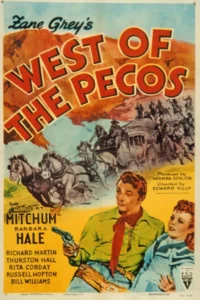
A young Robert Mitchum stars in this Texas-set story about a wealthy man and his daughter moving West and getting caught up in the drama of the frontier. Frankly, the beats of this movie are neither compelling or original. There’s a stagecoach robbery that happens in the beginning and it drives some story movement but really it serves as the branch for the foliage of love to sprout.

There’s a hardy comedic bend to the going-ons here. This Zane Grey adaptation kicks off in Chicago where Colonel Lambreth (Thurston Hall) is convinced by his daughter Rill (Barbara Hale) to move West to ease his deteriorating health. Quickly upon arrival, they are pulled into the life of Pecos Smith (Mitchum), a charming cowboy with a hardened edge. What stirs the drink is that Rill, after being harassed in town, decides to disguise herself as a man which creates a humorously tense relationship with Pecos as she flirtatiously challenges him at every turn. There’s a sort of a queerness to the story that works really well, even by modern sensibilities.

I do want to note here the role of the comical Chito Rafferty, played by Richard Martin. When I was looking up the background on West of the Pecos I discovered Chito appears in over 30 different movies, all played by Martin. The Mexican-Irish sidekick not only appears all over the West and abroad, but in several different time settings. Whenever gripes about comic book movie reboots or re-castings of legacy characters I can now point to the Chito Cinematic Universe as an example of the intelligence of audiences, even way back when.

The movie does a good enough job – it’s got the lightness of a classic Western with a dose of peril to keep the viewer on their toes.


#38. Jonah Hex (2010)
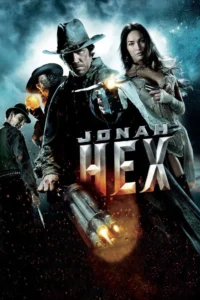
Josh Brolin, Megan Fox, John Malkovich, Will Arnett, Michael Fassbender (again), Michael Shannon, Lance Reddick, Jeffrey Dean Morgan.

Yep, this is one of the most squandered casts of all time.

DC Comics’ Jonah Hex is very likely the premiere comic book Western character (and a huge inspiration for the All-True Outlaw comics). Created in the ‘70s, the adventures of the ex-Confederate bounty hunter were catalogued in comics All-Star Western and Weird Western Tales. Later, cementing his appeal, Jonah was catapulted into increasingly odd scenarios, like post-apocalyptic futures and zombie-horror jaunts. The character always has had a slick relationship with the amazing and the occult, but absolutely can excel in more grounded realms too.

This concept was lost on the production team behind Jonah Hex, where nearly every aspect of the movie is dialed up to eleven. In an attempt to invoke the spectacle of the four-colored world, Hex can (somehow) speak to corpses, gunshots propel victims across rooms and explosions rupture from seemingly nowhere. The tropes of the West are overly baroque and severe. It’s like the European Western on Super Soldier Serum. This flick somehow learned the wrong lessons of Wild, Wild West, all while hitting a lot of similar story beats. Probably the most egregious thing, though? It’s set in the South! There’s this underlying post-Civil War commentary that does not land at all.

It’s essentially Red Dead Redemption: The Movie, which coincidentally debuted the same year. The actors move sort of like stiff NPCs, the internal physics are bombastic, and there’s outlandish oddities like an underground fight club featuring a snake-man from “halfway across the world”.

It’s pretty much universally understood to be a very bad movie, and going in knowing that…I actually sort of like it more than I did seeing it for the first time about fifteen years ago. It’s just an absurd piece of art, a twistedly misguided homage to both films and comics, and with generally good performances across the board, you could do worse in the genre.


#39. Dead Man (1995)
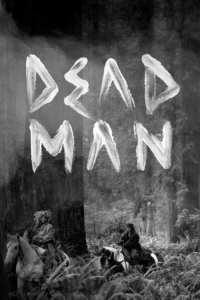
“Every night and every morn’, Some to misery are born, Every morn’ and every night, Some are born to sweet delight, Some are born to sweet delight, Some are born to endless night.”

The cult classic Dead Man, directed by Jim Jarmusch, is sort of a herald of the type of Western that would be popular for the next couple decades. Artsy, thoughtful, with a heavy swath of weirdness, it marries the old films of the American frontier with modern technique.

This is where the descriptor labels before the word “Western” gets muddled. The term “Acid Western” applies here, for sure – it’s very likely the epitome of that subgenre. But it also skitters into “neo-Western” territory. From casting choices to soundtrack to literary allusions, it’s a piece that portends the future of filmmaking. There’s a lot to admire here, but also, damn this thing is just a bit full of itself.

Scenes drag on a great deal longer than they need; the tone whips you around like a ride on a bucking bronco; the characters pontificate and monologue just for the sake of filling the air with sound. There’s a lot about Dead Man that I didn’t “get”, which in some ways makes it an fantastic Acid Western, but not a great movie.

Johnny Depp stars as William Blake, a numbers-man from Cleveland who relocates to the West for a job but quickly finds himself in peril when he murders a man in self-defense. He takes a shot to the chest and flees, only to be found by Nobody (Gary Farmer), a sorta-exiled Native brimming with thoughts of wisdom. Nobody informs Blake that the still-lodged bullet will kill him soon enough and the pall of death hangs over Blake in every step and action. The audience is on a ride along toward his inevitable death.

The movie is littered with a heap of good-to-great performances. Most notable is Robert Mitchum, in his final film role, as the town boss, but we also get great (albeit brief) stuff from Billy Bob Thornton, Alfred Molina, Michael Wincott, Crispin Glover and others. Depp is pretty good, as well, though he’s so confused and reactive in this that he’s more a good scene partner for the other actors than a leading man.

Neil Young provides the soundtrack with the very improvisational approach of riffing on his electric guitar, which adds a lot to the overall disjointed, stumbling nature of the whole affair.

I didn’t love this movie, but also think it’s a near must-watch for Western fans. It does a lot with a little, even if it has you checking your watch occasionally.


We’re chugging along like a brand-new locomotive here. Return to our pasture on October 6th, 2025 for a Western comic much in the build of some of these movies we just reviewed.


Westward!


~Jamil
Project: 100 Westerns: Part Eight: Last of the Wild Horses; Stars in My Crown; Shanghai Noon; China 9, Liberty 37

Salutations street-toughs,

Welcome back to Project: 100 Westerns!  We’re approaching the one-third mark in my endeavor to watch 100 Westerns, and I’m starting to get a little more adventurous in my picks. This quartet might be the most dissimilar group I’ve tackled yet.

Read on, loyal reader!


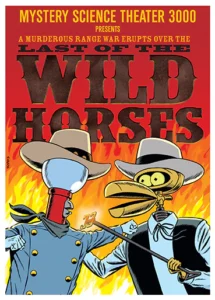
#28. Last of the Wild Horses – MST3K Version (1948/1994)

“Here’s where the sepia tone really pays off.”

Since we slid a bit in Sci-fi with this month’s release of Glistening Scar (by Dan Lauer, Amal Desai and myself) I thought it apt to rope in one of my all-time favorite TV shows: Mystery Science Theater 3000.

If you’re not in the know, MST3K stars the literal captive audience of a normal human dude and a pair of robots, documenting their mockery of a real-life bad movie. The features very often tilt toward science-fiction realms, but not always, as is the case of Last of the Wild Horses.

It’s a sloggy movie, gray as hell with terrible audio quality. It follows Duke (James Ellison), a bandit on the path to reform after his recruitment onto a horse farm. There’s a romance with the farmer’s daughter somewhere in there, and a smattering of frontier (in)justice, for good measure. This is a paint-by-numbers Western in just about every way. Except the palette is gray, light-gray, almost white, storm cloud and ash.

For fans of the show, this episode is famous for a Star Trek inspired switcheroo: in a multiversal accident, the series’ villains, Dr. Forrester and his sidekick TV’s Frank (aka The Mads) are the ones in the theater mocking the film through the first segment. It’s a treat for the aficionados, and a hidden gem in the deep catalogue of “experiments” constituting the show’s run.

In terms of the movie inside the TV show, I think one needs the MST3K enhancements to get through this piece of cinema. As Crow complains about halfway through: “The movie’s just starting to mosey now! The pace is rough sledding, and this viewer can only handle so many transition shots of people walking someplace before the scene even bothers to start.


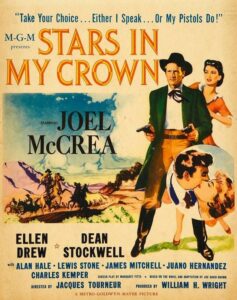
#29. Stars in My Crown (1950)

This is labeled Western but is more of a “Southern”. It slants way more toward “historical piece” than “adventure story”.

For the creative conglomerates that produced a film like this, something like Stars in My Crown are the tales of their (great-)grandparents, the happenings still in the living memory of their elders. And indeed, it’s based off of a novel by Joe David Brown, inspired by the memory of his preacher grandfather.

The movie sort of starts out like a traditional Western: a parson named Josiah Gray (Joel McCrea) saunters into the town of Walesburg, Tennessee and immediately enters the local saloon to give a sermon. When the unruly patrons scoff at this attempt, Gray pulls out two handguns and continues to preach at gunpoint. This sets up the parson as a no-nonsense type with a bit of a jagged edge, but honestly, this aura of gruffness dissipates quickly through the first act. Guns and power play only a small part in this story.

Rather, the film revolves around the challenges of Gray to bring more morality and kindness to Walesburg. The slow building A-plot concerns freed slave Uncle “Famous” (Juano Hernandez) as he fends off a wealthy mine owner looking to obtain his land; the B-plot turns on an outbreak of “slow fever” that pits the parson and the town doctor (James Mitchell) against each other in an ideological spat.

The story overall is a bit Pollyanna, but pleasant and put together well. Gray continuously inspires the town through his good nature and the adherence to his values and teachings, and the final scene or two are quite charming and earned. It also gets a few bonus points for one of the best character names I’ve ever seen – Chloroform Wiggins.


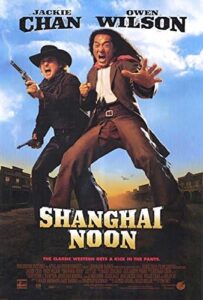
#30. Shanghai Noon (2000)


There’s a large bracket of folks who were raised during the Age of (Cable) TV, which I would loosely define from the 1960s until about a decade ago. For these watchers, certain movies or programs seem to be stalwarts of the medium. The reruns were constant, and the stuff that played repeatedly become ingrained into the cultural zeitgeist.

Shanghai Noon certainly fits into that category, for me, at least. This movie appeared in the scrollable channel guide a whole lot in my teen years, but to be honest, I’m not entirely sure I ever really watched it front-to-back. It was definitely one of those movies you sort of flip on and play in the background until you find something better to do.

Honestly, I forgot the reason a station would put a movie like this into heavy rotation is because it’s actually pretty good.

In the current age of Western, where the current offerings slant generally into either “low-budget” or “arthouse” we need more movies like Shanghai Noon. The movie follows the buddy flick formula, teaming two oddballs on a mission full of action and humor. We have Owen Wilson’s Roy O’Bannon – who we discover in the last minute is also somehow Wyatt Earp – a womanizing thief recently expelled from his own gang, and Jackie Chan’s Chon Wang – a play on “John Wayne” – a Chinese Imperial Guard on a mission to save an abducted princess (Lucy Liu). This plot and casting is pretty obviously trying to catch and harness the magic of Chan’s mega hit Rush Hour, and it comes very close to achieving that vibe.

The movie plays off of a lot of the Western tropes for comedic effect, but stops short of satire or parody. It’s an absurd movie, and the tonal quality is just right, for the most part. There are amazing comedic sequences (of note is the scene where Roy and Chon get blitzed in bathtubs) and Chan’s action choreography injects a super fun element into a fairly average series of plot churns.

This is a good popcorn flick, and it almost makes me want to take back what I’ve said previously about the Comedy Western’s effectiveness. There’s a lesson here about what tenor and inspiration this subgenre should take on, and generally the Western needs more high concept ideas and a more high-flying atmosphere if it wants to attract mainstream audiences again.


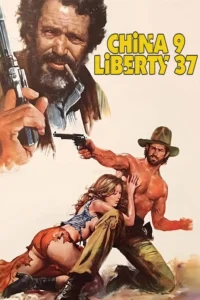
#31. China 9, Liberty 37 (1978)

“I need you tonight, and I hate you for it.”

No, you’re not reading the score of an odd football matchup. This methodical Western (with a heavy tint of love story) is led by Fabio Testi and directed by Monte Hellman. It was released in 1978 under the title Amore piombo e furore (“Love, Lead, and Fury”) but didn’t reach the US until 1984.

Basic plot rundown: Mere minutes before his scheduled hanging, gunfighter Clay Drumm is tasked by a railroad company to kill a man whose property they covet. After spending a few days with Matt (Warren Oates) and his wife Catherine (Jenny Agutter), Clay decides against murder…but does engage in an affair with the wife, which leads to the pair fleeing a scorned Matt and his clan. Bullets fly, the damsel changes hands a couple times and the guy on the horse tries to save the day.

The movie leans heavily on extended takes, cheesecake/beefcake and a lively soundtrack. The flavor of the Italian-Spanish Western is as thick as Testi’s accent. It takes a long, long while for the audience to feel the friction of the plot. Maybe a third of the movie is spent introducing us to the characters and their surroundings, and in formulaic fashion, the last third pops with gunfire and sex. What normally keeps a movie like that afloat is either compelling camera work or inspired repartee, neither which isn’t exactly crackling in this. The dubbing and audio is a speck slipshod, as well. I try not to watch with captions but this time I just had to.

The romance at the heart works via the effort of Testi and Agutter. The atmosphere of syrupy lust is sometimes too thick, the attraction between Clayton and Catherine is prominent and immediate. It’s not until much later in the film, after danger has entwined them even further, that you feel their genuine connection and a fear for their romantic future.

I liked China 9, Liberty 37 more than the other Hellman (Ride in a Whirlwind) and Testi (Dead Men Ride) films I’ve previously reviewed for this column. It has a jumbled morality and a bare plot but the steady quality provides enough juice to get you to the ending credits.

Good movie! Though, I would still like to see The People’s Republic of China and Liberty University play football.


This was maybe my smoothest group so far. Nothing felt like a chore.

We have a new comic release on Aug 4th, 2025! A revenge story gone wrong!

And remember to follow on the social accounts: Instagram, Bluesky, X and Facebook! Every like, comment and share helps us exponentially.

Westward!


~Jamil