Project: 100 Westerns: Part Twelve: The Stranger Wore a Gun; Kansas Pacific; Old Henry

Hello Westerinos,

Welcome back to Project: 100 Westerns! I’m still scuttling along, watching Western movies from across a hundred years of Hollywood.

I ran short on time this month and only eye-zapped three pictures. Two from 1953, the height of Western mania, and one candidate for the best, most-recently released genre offering.


#44. The Stranger Wore a Gun (1953)
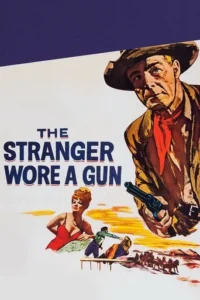
Based on a short story by John W. Cunningham (who also wrote the story in which High Noon is adapted from), this quick-hitter Western is mostly forgettable despite the notable cast.

Fan favorite Randolph Scott plays Jeff, a former spy in the Middle West theater of the Civil War. Becoming disillusioned by William Quantrill’s unsavory actions, he enlists as a regular solider for the Confederacy, and when the fighting’s over he fuck offs to Arizona to reinvent himself. The following plot is frankly, a bore: Jeff (going by “Mark Stone”) seeks redemption for his sordid past and attempts to thwart a criminal businessman in his attempt to rob a local stage coach operation. 

The Stranger Wore a Gun is a morally confused movie that is too flat and conventional to hold this viewer’s attention. The cast keepsit together, Scott, who frankly I haven’t been too impressed with in the handful of his Westerns I’ve watched, is a capable leading man, and the heavies, played by Lee Marvin and Ernest Borgnine in their baby-face era, approach “interesting”. There’s a hazy romantic thread with Claire Trevor’s character in this too, but it gets sorta hijacked by Joan Weldon’s townie role. 

The quirky element of this film is that it was originally filmed for 3D, so there’s a bunch of jarring shots of actors throwing punches or shooting lead straight toward the camera lens, which his essentially lost in the modern 2D print. The project as a whole serves as a time capsule of both Westerns and the film industry, which is basically true of a lot of the films I’ve reviewed, but hey, I’m trying to be gracious here.  


#45. Kansas Pacific (1953)
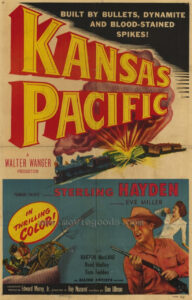
Here’s another film from 1953, and another use of William Quantrill as an antagonist, which is at least the fourth time a Project: 100 movie has featured the radical guerrilla fighter. Sort of weird how some names drop from the zeitgeist, right?

This is technically a Western, but also more of a political thriller. A Captain in the Army Corp of Engineers (Sterling Hayden) is sent (undercover) to Kansas to help oversee a railroad that will be instrumental in the inevitable Civil War. Upon arrival, he is tasked not only with the hiring of workers and the logistics of a huge infrastructure project, but must also contend with Southern sympathizers seeking to destroy the railway.

Hayden plays the lead stiffly, which sort of works as he’s a direct military guy with the narrow mission of building a thing quickly and proficiently. The plot ramps steadily, first the Captain needs to survey the thorny situation, recruit and retain railmen, and then tamp down the pro-South saboteurs. There’s some neat maneuvering between the two factions as they attempt to achieve goals without heavily exposing their motives or members. It’s not until the last portion of the movie that we get some (welcomed) explosions and gunplay.

It’s a pretty inane movie, plainly. Director Ray Nazzaro does a fine enough job: the camera work carries this for the most part, but there’s very little for the actors to do, overall.


#46. Old Henry (2021)
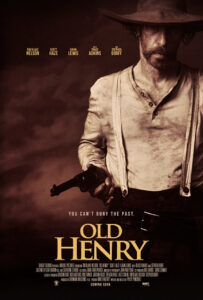
“You have no idea the hell storm you’re about to let loose”.

If you’re looking for the best Western released in the last five years, you’ve found it.

Tim Blake Nelson, a top-tier character actor in the modern age, stars as Henry McCarty, a farmer in Oklahoma Territory who lives with his teenaged son. When an injured stranger wanders into their life, Henry is confronted by a trio of lawmen who threaten his homestead , demanding the return of the alleged outlaw.

That’s all I can give you on plot specifics, because wow, this one takes you for a ride.

What immediately leaps out at you from the screen is the effortless way the script relates the intelligence and savvy of its characters to the audience. Henry is a seasoned guy, from his folksy bits of poetic advice, to how he handles a shovel or gun, it’s apparent this guy has been around and is pretty much over all of it. His counterpart, the villainous Sheriff Ketchum (Stephen Dorff), is equally as astute and clever, making for a perfect foil.

Writer/director Potsy Ponciroli achieves all he set out to do, and more. It’s a well-shot movie, featuring dynamic horizons and ferocious bursts of violence. The rolling hills of the Tennessee (posing as Oklahoma) locale makes for a defining setting, and lets the viewer know this tale is far from the dusty valleys of the Southwest, which is mentioned frequently as a place the characters are familiar with.

I had heard this movie was a gem, and it did not disappoint. A testament that you can still make an awesome genre film on a budget.


Be sure to check back in on December 2nd 2025! We’ve got a special holiday Western that I’m itching to show yunz!


Westward!


~Jamil
Project: 100 Westerns: Part One: Barbarosa, Campañeros and Decision at Sundown

Over the next twelve months I’m going to attempt to watch 100 Western flicks.

The math is simple, right? Two a week should get me there. That’s not too crazy. Right?

I’ve seen a good number of Westerns. Not as much as your dad, likely, but more than the next 30-something dude from urban Appalachia, There’s still so many out there. Studios cranked out copious Old West-set films for about four decades. Nearly one in four movies that came out in the 50s and 60s was in the genre, and they’re still pumping them out today in the Neo-Western style. Speedrunning the catalogue could be considered stupidly ambitious, but it’ll be fun to see how the art of storytelling has changed, adapted and evolved over the decades.

No particular rhyme or reason to my picks. I’m just throwing darts at what’s interesting, mostly stuff I’ve never seen, however many selections will be favorites or something I’d like to give another shot. If you have suggestions, let me know!


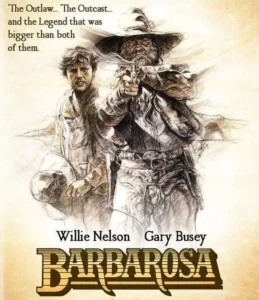
#1. Barbarosa (1982)

I watched this one after seeing it mentioned on reddit as one of the best 80s Westerns. It was a super average, but deserves at least one watch from any aficionado.

Willie Nelson and Gary Busey do a sort of buddy outlaw thing, menacing folks through Texas and Mexico. Both men’s families are thirsty for revenge and it’s a little ambiguous how justified it is.

Busey is made for the role of slightly likeable bumpkin, and Willie is sublime as the sly road agent type. The tone of the movie never settles, it’s got brutal imagery and nasty protagonists yet is pretty lighthearted overall. Not a lot of great lines in the movie but there are a few laughs. The cinematography is really good; the vast beauty of Texas sets the mood.

The ending is rad. The execution wasn’t great but I loved how they played up the ongoing mystique of Barbarosa (did he deflect a bullet with his face there at the beginning?) while making him relatable to the viewer. Overall, pretty good but somewhat short of remarkable. It’s worth a watch for Willie alone


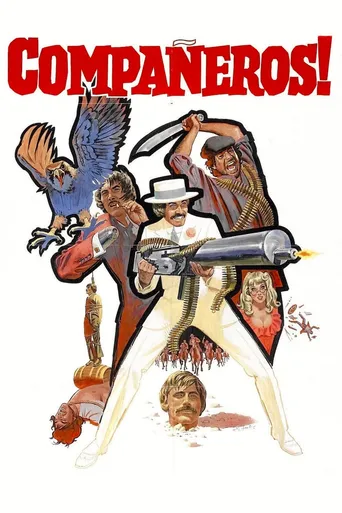
#2. Campañeros (1970)

This one practically comes with a side of garlic bread

The acclaimed Django director/actor combo reunite in this fun Spaghetti Western that also features familiar faces Tomas Milian and Jack Palance. The buddy movie genre, comedy to drama, lends itself really well to Westerns. There’s so much space for eccentric characters, and there’s a bunch of them here.

Franco Nero plays “Penguin”, a well-dressed, Stockholm-born rogue, and Milian is “Vasco” a crass Mexican rebel. They team up to track down (and eventually jailbreak) a preachy professor so they can open a safe containing the town of San Bernardino’s “wealth”.

Both men are avowed assholes, and it’s fun to watch them bounce that energy off each other. Vasco is bit of a dunce, but earnest and capable. The Penguin is played extremely well by Nero, whose every phrase and gesture is dripping in gentle smarm. They’re a great odd couple — Vasco is a killer and fiend in a way necessitated by his environment, the Swede very much has sought out a life of crime and chaos.

We need to discuss Palance’s character… An American simply named “John”, Palance uses his Skeletor visage to build Bond-villain aura around the film’s prime villain. He’s got an absurd haircut, a pet hawk, a wooden hand, a bunch of joints and an absolutely inexplicable accent. He tortures Vasco by  strapping a rodent to his torso! It’s a crazy role for a guy essentially doing his second tour through film acting at this point in his career. Loved it.

The slick direction by Sergio Corbucci shapes Campañeros and makes it quality. But wow is this thing Italian. The dubbing is rough, and there’s a lot of regional accent and gestures slipping through, breaking immersion. Some of the background and secondary actors, oh my. The script is surprisingly strong though, and just when you’d expect an unimpressive petering off the final act slams the viewer with a series of cool and earned moments.

Oh and that soundtrack hits harrrd.

A pretty good movie, very representative of the time and place it was made. A little goofy at parts but it gets points for the general depth of the characters


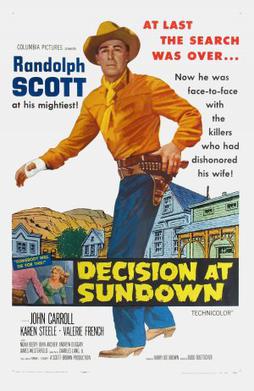
#3. Decision at Sundown (1957)


In this heyday Western, Randolph Scott plays against type as a man lusting for revenge, inadvertently freeing the town of Sundown from the grasp of big boss Tate Kimbrough. It’s a something of a stomach churner, lots of bad feelings and angry words fly between Kimbrough (played by John Carroll) and Scott’s Bart Allison, and while the movie fails in spots it represents a bridge between the Classic Western and the soon forthcoming Revisionist era. 

With plenty of shooting and pageantry, Decision at Sundown hits all the notes of the genre: good sets and costumes, ultra-competent acting and an eye toward a dynamic plot. It’s what you’d expect from a Budd Boetticher film, and for fans of the Ranown series it’d make for a nice watch on a Sunday afternoon. 

The movie sputters at the start, with the central drama not fully surfacing until the 2nd act. The thorny Bart Allison smolders and steams in the general direction of Kimbrough and then tries to disrupt his wedding, eventually revealing that the businessman courted his wife while Allison was at war, broke her heart and drove her to suicide.

This conflict is purposely gray and murky. After some gunplay and a lot of posturing, more details are unleashed on the viewer, and it sort of comes down to the theory that Allison’s wife Mary was maybe a bit of a ho-bag and their marriage wasn’t strong in any way that counted. 

This core premise is interesting and flips many of the conventions built by the genre over 20-30 years. An angry man rides into a small town looking for retribution and you expect his cause to be clear and just, but in Decision at Sundown, everything is distorted through the lens of perspective. Was Kimbrough a vile womanizer or just a dapper lady-killer? The movie sort of lets you in on the truth, but remains nebulous on what really went down between Mary and the two leads. 

It’s here the true flaw of the ambitious script appears. Mary is never given a voice, the viewer is denied a hint of what it was like on her side. Allison’s partner Sam, the only other character who knew Mary, certainly intimates that Mary wasn’t a great wife and the marriage was troubled, but we have very little inkling of her perspective. With her voice, I think this could have been a much better piece on the inadequacies of frontier justice. 

The real thing tying this together are the leads’ performances. Scott slides into the gray hat role extremely well, demonstrating his talent in bringing the truth of a character to the forefront. I thought Caroll matched him, taking the presumed antagonist and playing it with subtleness that questions the allegations against him. The two lead female roles, Lucy (Karen Steele), the daughter of a prominent townsperson and a babe, and Ruby (Valerie French), Kimbrough’s scorned-yet-loyal side piece, round out the male hostility with a woman’s touch and rationality. But other than that, many of the tertiary characters fail to impress. 

I liked this movie for its gusto but it was a touch before its time. The intent, commendable. Execution, eh. 


That is it for this first entry of Project: One Hundred Westerns, see you Januarary 6th, 2025 with the next All-True Outlaw comic!

Westward!


~Jamil