Project: 100 Westerns: Part Thirteen: Blindman; Against a Crooked Sky; Trail of Robin Hood; First Cow

Hi hosses,

This post is a week late, but hey, it’s the busy time of the year for a reason!

This selection of movies ended up being the most oddball so far. I picked these as random as most others, just whatever looked good on cursory glance, but all four deviated from what I was expecting.

Anyhow, this is the halfway point of Project: 100! Admittedly, I’m going at ~50% speed from what I was expecting, but watching movies AND thoughtfully reviewing them is not easy work, especially when comicking is the main priority.


#47. Blindman (1973)
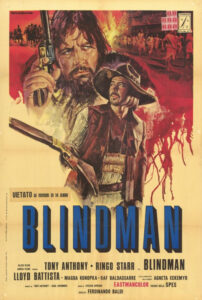
First up in this platter of weird-ass movies is an Italian Western written and starred-in by American Tony Anthony, modeled after the Japanese character Zatoichi . Predating Red Sun by three years, this is considered the first Cowboy/Samurai mashup attempt, and for that, I’m required to give some kudos.

The tonal frequency of this movie is tough to discern. It’s got the hallmarks of a Spaghetti — it’s brutal and direct and ironic — but there’s an American sense of humor in it, too. It’s almost slapstick-y; the visually-impaired protag fumbles around the plot, dodging not only bullets but also a host of bad guys looking to take advantage of him.

The plot: Ciego, known to the community as “Blindman”, embarks on a mission of retribution after being bilked by a colleague on the payment for the delivery of 50 mail-order brides to a group of miners. That semi-absurd story detail is brushed aside as an everyday transaction (fifty??), and Blindman subsequently works his way up the syndicate chain for restoration of his business loss.

A notable actor in this movie is Beatles star Ringo Starr, who plays one of the main heavies. Despite Ringo’s rep as a terrible thespian, he’s actually not too bad in this, doing a fine job as the antagonist Candy.

Blindman is fascinating in that it’s grounded for such a fantastical premise. Worth a watch if you’re into the Euro-style Western, though don’t expect to be too impressed by what you (ahem) see.


#48. Against a Crooked Sky (1975)
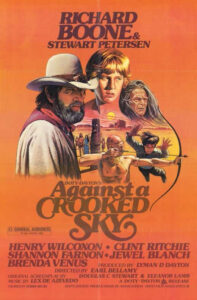
“You know, I had a boy like you once. He was as ugly as dirt. Took after his ma. I ended up having to slit his throat.”

Richard Boone is one of my favorite Western actors. Whether it be Paladin from Have Gun – Will Travel, or the many baddies he’s played in films like Hombre or Robbers’ Roost, he brings a strong presence to the screen, often enchanting the performance of his scene partners.

Against a Crooked Sky is a bit of a different beast. In this, Boone plays “Russian”, a crotchety prospector who spouts off folksy wisdoms and makes goofy-ass throaty sounds as a matter of habit. It’s a alternate speed for Mr. Boone, in one of his final roles.

His screen companion is Stewart Peterson, who plays a preteen on the search for his recently abducted sister. This is a sad sort of movie, from the soundtrack to the characters’ backgrounds and dispositions, there’s a real Revisionist quality to it all. The story opens with the troped-up specter of Native violence, but it does give the Indian characters some agency by the end.

The movie is mostly carried by Peterson, who gives a great performance as an eager, valiant boy trying to save his sibling’s life. He and Boone make a fine mismatched pair, which carries the story for the most part. The thoughtful shots of the mountainous Utah terrain are also a boon (heh), which helps ease out some of the more awkward elements of the project.

Against a Crooked Sky straddles the fence between fine and forgettable, nothing really pops. For the most part it does the job it set off to do, and does manage to give us a bittersweet ending that feels earned.


#49. Trail of Robin Hood (1950)

We asked the Google machine for a Christmas Western, and this is what it spit out. Some additional googling helped provide the context on this movie, which is essentially Cowboy Avengers.

When we’re talkin’ 1950, we’re speaking of the height of the Western film, where studios were pumping out genre flicks like a torrent from a hose. Thus, there was a huge pool of actors who operated primarily in that field, many of which show up here.

Roy Rogers, both actor and character, is the lead in this, and most of the cast are dudes playing themselves in a contrived story about fraud at a Christmas tree farm. It is one part Western, another part studio stunt. For the most part, these actors were recognizable, and this sort of movie was intended as a meta treat for fans, particularly kids. It’s the embodiment of the Leo Pointing meme.

The movie’s a drag, though. There’s a lot of winking and nudging toward the audience about these apparently retired actors suddenly all working together to thwart a X-mas scheme against the poor. Moreover, Christmas barely plays a role in the happenings, there’s the trees, obviously, and a couple get-togethers, but nothing about the most joyous of seasons is prominent to the themes or messages of it all. We do, however, have the choice of saturating the visuals through a red and green tint. It changes most of the outfits to an elven green and the actors’ faces show as bumblegum pink. It’s fucking strange!

But the craziest thing, overall? No mention of Robin Hood in the entire script. There’s a bit of an altruism bent within the main conflict, but there’s, like, no reason at all to evoke the bandit from Sherwood. Overall, a strange time capsule of the movie biz and its sensibilities.


#50. First Cow (2021)
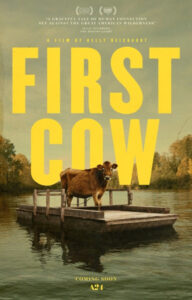
No way for a poor man to start. You need capital, or you need some kind of miracle. You need leverage. Or a crime.

Director/screenwriter Kelly Reichardt is a filmmaker who operates mostly in the “slow cinema” realm. You know these movies: patient, light-on-plot, contemplative, with an emphasis on humanity and its relationship with setting. The Western genre is built for it, really.

First Cow may be the most methodical entry yet in Project: 100. It takes its good ol’ time. Lingering shots and pregnant pauses eat up the two hour runtime life you wouldn’t believe. There’s a charm to that, sure, but I got places to be, movie!

The story follows two men in 1802s Oregon County: Cookie (John Magaro), a quiet frontiersman baker, and Lu (Orion Lee), a business-minded Chinese immigrant. It’s a decent “mountain man” story, the era of settlement that laid the foundation for the “wild west”. You can particularly smell the dampness of the environs. The sight of wet ground, the flashes of fauna, the rustling of wind on the trees; this flick is excellent at making the viewer feel the Pacific Northwest in all its green/brown glory.

It took me about 40 minutes to grasp the general direction of the plot, which is mostly about Cookie and Lu stealing milk from a wealthy British man (Toby Jones). It’s a story of survival and friendship, and slants hard away from most markers of a traditional Western. It’s a very, very chill movie.

Not a bad watch, at all, but you’ll probably find yourself looking at your watch/phone a few times during the viewing. It’s in no hurry to tell a story, and by the time you finish you’ll have to sorta fill in the blanks for yourself. It absolutely refuses to hold your hand, which can be refreshing but also a challenge in media literacy.


That’s all for the 13th leg of Project: 100. My goal for the next year is to ramp these up a bit, either do a few more movies per post or a few more posts per month. We’ll see. As always…

Westward!

~Jamil
Project: 100 Westerns: Part Seven: Black Patch; Hombre; Noose for a Gunman; Quantum Cowboys

Hi homesteaders,

This is another post for Project: 100 Westerns, where I watch anything under the genre umbrella and tell if you rocked or sucked. I’m fixin’ to watch 100 Westerns, no matter how long it takes me.

In this group of four, I took in a trio of movies from the heyday of Western filmmaking, and one that is very modern, both in production date, subject matter and technique.


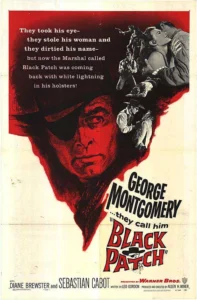
#24. Black Patch (1957)

In a different era of Hollywood, there was no blueprint. Nowadays, the blueprint is coda.

What I’m cleverly trying to say is: things are way, way too formulaic now. Studios are taking few chances on anything “new”, while still trying to catch and retain “flashy”. This doesn’t just manifest in the bevy of franchises that hit the screens each year, but in the way these stories are told, as well.

Black Patch isn’t a great movie, but at least it’s interesting in structure and pace. There’s an element of it that feels novelistic, with its squishy characters wrestling with real consequences. We’re quickly introduced to “Black Patch” (George Montgomery) nicknamed so for the garb he wears over his eye lost in war, but in a previous life he was known as Clay Morgan. That past saunters into his present when his old Army pal, Hank (Leo Gordon — also the script writer!), enters the town with Clay’s former flame, Helen (Diana Brewster), as his wife. There’s another hitch – both men have new careers. Clay is a town marshal, and Hank a thief.

This stirs the drink well, and leads to some interesting plot dynamics that had me guessing until the very end. Side character Carl (also known as Flytrap), whom I previously known as Marv from High School Big Shot (a classic Mystery Science Theater 3000 episode) ascends from goofy side character to interesting menace, which helps kick the story along, even as other elements sputter by the end.

I liked this one, it’s got a different speed and plenty of pathos, even if it could have been a deal better in the third act.


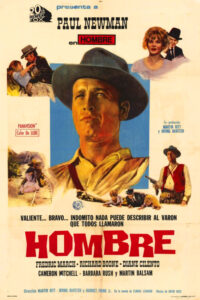
#25. Hombre (1967)

Dr. Favor:
“That’s something you’ll learn about white people. They stick together.”

Hombre:
“They’d better.”

This is very likely the best film I’ve seen yet in Project: 100.

“Methodical” is the one word descriptor, applying to both pace and lead character. “Hombre” (née John Russell) is a smooth bro, calm in words and gait, and really doesn’t have time for any of your bullshit.

To dub this one of Paul Newman’s best performances would be a spicy take, his legendary filmography stands tall, but considering I’ve never heard of this film I’m going to say it’s an underrated entry in his catalogue of roles. Hombre is not a man pleased with the general nature of the “white world”, having been raised by Apache Indians from a young age, however when his adoptive (Caucasian) father dies and leaves him a piece of land, he ventures back into civilization.

Hombre surprisingly sells the boarding house property, catching the mild ire of acting landlord Jessie (Diane Cilento). They both catch the next stagecoach out of town and a bulk of the story is then told on the desert road. We get an interesting mix of characters in the horse-drawn vehicle, a host of personalities that clash and sway together extremely well from the jump. Also on board are a young couple unsatisfied with their time in the West, an affable Mexican driver, a doctor and his young(er) wife and a gruff, obliquely dangerous feller played by the always fabulous Richard Boone.

When this group of strangers find themselves in sudden danger, Hombre is compelled, reluctantly, to step up and lead them out of the desert. The most capable of the clan is hardly the most affable, and it leads to a lot of snappy dialogue with plenty of snips. The movie’s script is fantastic, and I’m curious how much dialogue is pulled straight from the 1961 Elmore Leonard book it was adapted from.

It’s got the blood and brawn of a standard Western flick, with some heart and guts to go along with it. A really good movie that boasts a blend of styles from the dying Tradition age and the forthcoming Revisionist era.


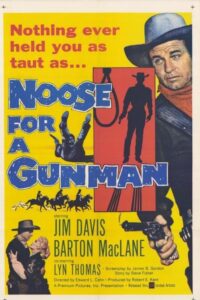
#26. Noose for a Gunman (1960)

The Steve Fisher short story “The Fastest Gun” was adapted into film three times over nine years. This is the second such attempt.

It’s fascinating that this movie was made within a decade of Hombre, the two films are so stylistically different it was jarring watching them so close together. That’s one of the neat things about this Western watching venture – witnessing the evolution of Hollywood and the medium of film. Whereas Paul Newman’s movie was “methodical”, Noose for a Gunman is plainly “stiff”. The actors spit out their lines like regimen, the action is tight, the personalities are narrow and direct. Early Westerns had this idyllic vibe that later iterations seemed to have shunned completely. Purposely so.

Jim Davis plays Case Britton, a hired gun who returns to his hometown of Rock Valley five years after murdering the sons of its biggest rancher and benefactor. Rock Valley balks at his sudden appearance, some even call for his immediate arrest and hanging, but Case still has friends in town, and is determined to meet his future bride, Della (Lyn Thomas), when she arrives via stagecoach.

Case deals with antagonism on many sides, from the rancher, Avery (Barton McLane),  to his hired muscle Link Roy (Leo Gordon, again) and gang leader Cantrell (Ted de Corsia), this keeps the movie churning and interesting enough to grab this watcher, but right around the time Case becomes the town’s new marshal, I sort of checked out a bit. I do give credit to the climax however, which provides a bit of fun gunplay and the impressive choice to allow Della to play the hero in a tense moment.

I’m curious as to how the other two films adapted “The Fastest Gun”, it’s got the bones of a decent, though super formulaic story, but I didn’t see much to brag about in Noose for a Gunman.


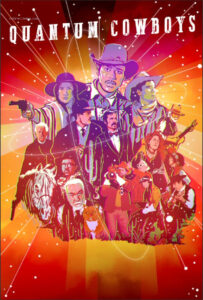
#27. Quantum Cowboys (2022)

One of those “what the hell did I just watch?” movies.

A metafictional Western that uses several animation styles as well as live-action, Quantum Cowboys challenges the viewer to keep up, even as it scuttles ahead at warp speed. It’s the brainchild of Geoff Marslett, and commendable in its subject matter and technique, but at times I found it a little too wonky and unfocused to be a winner in the genre.

The movie oscillates between several viewpoints, from the co-lead cowboy types, to a narrator akin to Utau the Watcher, and a voyeuristic film crew seemingly manipulating some events. As you may glean from the title, there is an element of time travel in the plot (and themes!) and heady ideas about memory and reality are poured onto the audience within the first few minutes.

The basic gist: Frank (Kiowa Gordon) and Bruno (John Way) are a pair of friends who get wrapped up in temporal hijinks, and bump into a host of weirdos, including a lady drifter-type played by Lily Gladstone. It takes a long while for the plot to adjoin the puzzle pieces, but the psychedelic, cartoony cinematography kept me into it as I waited for the story to cohere.

The third act delivers some payoff, but also falls victim to the tropes of time travel stories, and then sort of just ends without a direct resolution. There’s a notation that this is the first part of a larger story, though given how off-the-wall the themes and editing are, I almost feel like the abrupt final moments were an intentional troll.

Lots of points for ambition here, and I could even be convinced to watch it again.


An interesting bunch, to say the least. I’m realizing now I maybe should have group some of these thematically. It certainly would have been easier to write!

Please return July 7th, 2025 for a brand new All-True Outlaw comic! That’s eight in eight months, if you’re countin’!

Westward!


~Jamil