Project: 100 Westerns: Part Twelve: The Stranger Wore a Gun; Kansas Pacific; Old Henry

Hello Westerinos,

Welcome back to Project: 100 Westerns! I’m still scuttling along, watching Western movies from across a hundred years of Hollywood.

I ran short on time this month and only eye-zapped three pictures. Two from 1953, the height of Western mania, and one candidate for the best, most-recently released genre offering.


#44. The Stranger Wore a Gun (1953)
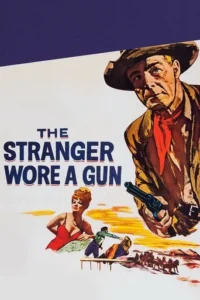
Based on a short story by John W. Cunningham (who also wrote the story in which High Noon is adapted from), this quick-hitter Western is mostly forgettable despite the notable cast.

Fan favorite Randolph Scott plays Jeff, a former spy in the Middle West theater of the Civil War. Becoming disillusioned by William Quantrill’s unsavory actions, he enlists as a regular solider for the Confederacy, and when the fighting’s over he fuck offs to Arizona to reinvent himself. The following plot is frankly, a bore: Jeff (going by “Mark Stone”) seeks redemption for his sordid past and attempts to thwart a criminal businessman in his attempt to rob a local stage coach operation. 

The Stranger Wore a Gun is a morally confused movie that is too flat and conventional to hold this viewer’s attention. The cast keepsit together, Scott, who frankly I haven’t been too impressed with in the handful of his Westerns I’ve watched, is a capable leading man, and the heavies, played by Lee Marvin and Ernest Borgnine in their baby-face era, approach “interesting”. There’s a hazy romantic thread with Claire Trevor’s character in this too, but it gets sorta hijacked by Joan Weldon’s townie role. 

The quirky element of this film is that it was originally filmed for 3D, so there’s a bunch of jarring shots of actors throwing punches or shooting lead straight toward the camera lens, which his essentially lost in the modern 2D print. The project as a whole serves as a time capsule of both Westerns and the film industry, which is basically true of a lot of the films I’ve reviewed, but hey, I’m trying to be gracious here.  


#45. Kansas Pacific (1953)
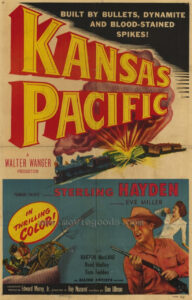
Here’s another film from 1953, and another use of William Quantrill as an antagonist, which is at least the fourth time a Project: 100 movie has featured the radical guerrilla fighter. Sort of weird how some names drop from the zeitgeist, right?

This is technically a Western, but also more of a political thriller. A Captain in the Army Corp of Engineers (Sterling Hayden) is sent (undercover) to Kansas to help oversee a railroad that will be instrumental in the inevitable Civil War. Upon arrival, he is tasked not only with the hiring of workers and the logistics of a huge infrastructure project, but must also contend with Southern sympathizers seeking to destroy the railway.

Hayden plays the lead stiffly, which sort of works as he’s a direct military guy with the narrow mission of building a thing quickly and proficiently. The plot ramps steadily, first the Captain needs to survey the thorny situation, recruit and retain railmen, and then tamp down the pro-South saboteurs. There’s some neat maneuvering between the two factions as they attempt to achieve goals without heavily exposing their motives or members. It’s not until the last portion of the movie that we get some (welcomed) explosions and gunplay.

It’s a pretty inane movie, plainly. Director Ray Nazzaro does a fine enough job: the camera work carries this for the most part, but there’s very little for the actors to do, overall.


#46. Old Henry (2021)
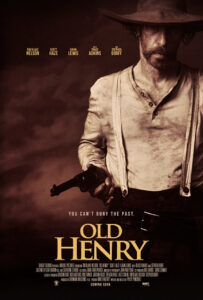
“You have no idea the hell storm you’re about to let loose”.

If you’re looking for the best Western released in the last five years, you’ve found it.

Tim Blake Nelson, a top-tier character actor in the modern age, stars as Henry McCarty, a farmer in Oklahoma Territory who lives with his teenaged son. When an injured stranger wanders into their life, Henry is confronted by a trio of lawmen who threaten his homestead , demanding the return of the alleged outlaw.

That’s all I can give you on plot specifics, because wow, this one takes you for a ride.

What immediately leaps out at you from the screen is the effortless way the script relates the intelligence and savvy of its characters to the audience. Henry is a seasoned guy, from his folksy bits of poetic advice, to how he handles a shovel or gun, it’s apparent this guy has been around and is pretty much over all of it. His counterpart, the villainous Sheriff Ketchum (Stephen Dorff), is equally as astute and clever, making for a perfect foil.

Writer/director Potsy Ponciroli achieves all he set out to do, and more. It’s a well-shot movie, featuring dynamic horizons and ferocious bursts of violence. The rolling hills of the Tennessee (posing as Oklahoma) locale makes for a defining setting, and lets the viewer know this tale is far from the dusty valleys of the Southwest, which is mentioned frequently as a place the characters are familiar with.

I had heard this movie was a gem, and it did not disappoint. A testament that you can still make an awesome genre film on a budget.


Be sure to check back in on December 2nd 2025! We’ve got a special holiday Western that I’m itching to show yunz!


Westward!


~Jamil
Project: 100 Westerns: Part Eleven: Red Sun; The Ride Back; Outland; Oblivion

Whoa Riders,

Ride along in High-Concept Country, we’ve got some more Project: 100 Westerns for yawl!

I typically use this space to tell you I selected movies at random, but this time, I was pretty purposeful in my picks — mash-ups and mindbenders!

Westerns are great fodder for mixed-genre stories. We see it all the time in sci-fi, but it appears in manga/anime, big-budget action, crime television, cartoons and so much more. I thought it might be neat to leap headlong into these types of movies and see how successful they can be through the iterations.


#40. Red Sun (1971)

“Now we’re even, though I’m a little more even than you.”

Sporting a cast of some of the biggest international stars at the time, Red Sun is an ambitious cultural mashup that explores the relationship between two men on different ends of the honor spectrum.

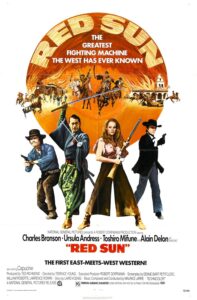
Charles Bronson plays Link, a scoundrel who is only redeemed by the nastiness of his partner, Gauche, played by Alain Delon. The two decide to rob a train teeming with gold, but in the process Gauche betrays Link and leaves him for dead, whilst also stealing a prized samurai sword from a Japanese ambassador. Upon awakening from his brush with death, Link is tasked by the ambassador to accompany his bodyguard Koruda (Toshirō Mifune) on the retrieval mission, to which Link reluctantly capitulates.

The cowboy/samurai adventure that ensues is a playful but sufficiently grave affair that uses the central tension of the two leads to keep the plot churning. Link and Koruda maneuver around each other while using their wiles and strengths in entertaining ways, and of course the theme of Mutual (Brotherly) Respect emerges toward the last act. Delon plays a fine baddie, sinister but with enough humanity to make his next action unknown and his beau, Christina (Ursula Andress), slips into the “prostitute with a heart of coal” role very well, too, adding to the turmoil and danger.

Additionally, like any Western worth its salt, the action/fight scenes are well done, as I’d expect from a Bronson-led movie. There’s some neat-o set pieces here, including the bloody final sequence in a burning cane field. The only real knock I have against the movie is the choice of a horde of Indians as the final antagonist. They present more as a force of nature than a group of humans, and there’s a real lack of agency since there are essentially no Native characters in the film.

This movie maybe is a little too cute for some, but I thought it was smart and well-made, and considering the close relationship between the Western and Samurai genres, it makes a lot of sense. I recommend simply on the cast and concept alone.


#41. The Ride Back (1957)

“When you ask questions you gotta wait for answers.”

I’m finding the “two frenemies go on a short trip together” trope to be quite popular in the Western genre. It makes sense, the conditions on the fictional frontier are hazardous and the populace generally untrustworthy. It works in movies like Red Sun and The Deadly Companions, though all three suffer from the same weak-tea “faceless Native” threat to inject danger into the plot.

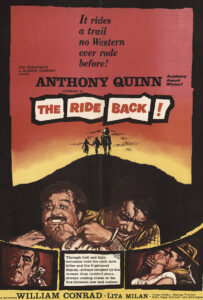
The Ride Back, written by Antony Ellis (adapted from a Gunsmoke radio show by the same author) and directed by Allen H. Miner, follows a predictable tune but hits the notes hard: Hamish (William Conrad) is a sad-sack lawman tasked with returning accused murderer Kallen (Anthony Quinn) back to the town of Scottsville to stand trial. The two, both on missions of self-preservation, clash routinely, which transforms into reluctant camaraderie in the face of danger.

Despite lots of Spanish (sans subtitles) in the first half, this movie is easy to follow and enjoy. The story points are minimal, but where the film blossoms is in the performances and dialogue. Conrad plays the battered Hamish with a low-simmering intensity, closed-off but increasingly fidgety in the face of complications. Quinn shows off his acumen with a charm and bravado that fills the screen. This is another one of those films that portends the genre’s Revisionist era by switching up conventions and subverting expectations. The “hero” is somewhat pathetic in his determination and his opposite almost has you cheering for more crime. There’s a underlying humor to the adventure, as well, with the two sniping at each other freely.

I liked this cozy movie — a brisk Southwestern trek through the psyche of the Western protagonist/antagonist dynamic.


#42. Outland (1981)

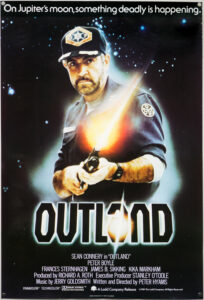
In this Space Western loosely based on 1952’s High Noon, a Marshal assigned to a mining facility on a moon of Jupiter is the lone opposition against the corrupt heads of said facility. Sean Connery stars as W.T. O’Niel, a man trying to find his purpose in a morally depleted world. We’re not told too much about O’Niel, he’s a petty stereotypical cop-dude, but the nuances from Connery’s performance colors the edges of the character well.

As a Sci-fi movie, Outland falls short of “good”, its concepts are too dated and not overly imaginative. This is very much “hard” sci-fi — a work of fiction with firm roots in actual science — which, compared to the tales of aliens and time-travel, is tough to pull off in an entertaining way. As a Western, it barely qualifies, the fantastical cosmic imagery is diametric to the very earthen shots of ground and grass. But as a Sci-fi Western it soars. The isolation, the danger, the lethal indifference of the citizenry and the setting, it’s all there, and done very well.

Connery shines as the curt and direct O’Niel, and he has two great scene partners: the ornery Dr. Lazarus (Frances Sternhagen) and Con-Amalgamated boss Mark Sheppard (Peter Boyle). Lazarus is mostly used to drop exposition and to talk through ideas, but damn are her cutting one-liners golden. Sheppard is the prime antagonist, the figurehead of corporate greed and apathy, and you can almost see this character/actor flourishing as a Bond villain in Connery’s previous cinematic endeavors.

The specter of dystopia and the cruelty of the environs infuse the movie with a sense of dread that is felt in the halls of the mining rig and found in the tired eyes of our characters. I think of this movie existing in the same universe as the Alien franchise, it shares the sooty retro-futuristic look and the themes of a dreary corporate bureaucracy which gobbles up the common man’s soul. Writer/director Peter Hymans massaged a fantastic remake out of a classic Western, and it amounts to one of my favorite Project: 100 viewings.


#43. RiffTrax: Oblivion (1994/2017)

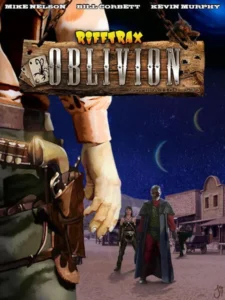
Imagine all the conventions and imagery of a sci-fi movie violently blasted onto the canvas of a quaint horizon depicting a sun setting over the Rockies. That’s Oblivion.

“Ambitious” is a kind way to put it. There is just too, too much going on in this movie which lists least people five under the “Story By” or “Written By” credits, including fame scribe Peter David. I can’t even succinctly relay it here, it’s so jumbled in focus and feel and leans so heavily on the language of its parent genres it feels insincere.

Of course, I expected a bad product when I fired this up because it’s a project by RiffTrax, a Mystery Science Theater 3000 offshoot that roasts poorly assembled movies as they unfold. The boys do not disappoint in their savagery. George Takei never stood a chance!

From the poor acting (you’ll cringe toward infinity from Julie Newmar’s belabored cat noises), to the absurd set design (ceiling fans count as futuristic, right??) there’s fertile ground here to mock. Even more transgressions: random ass side characters with paper-thin personalities, grueling meandering in and around low-budget locales, off-brand Muppets, boring stereotypes, random ass quotes from other movies and the gall to flash a “To Be Continued” message before the end credits.

That said, there’s a nugget or two of a good idea here, but as comic writer Dan Slott has put it: this suffers from “too many mojos”. It’s like a slapdash campfire story where each kid around the circle adds a little bit of their own favorite lore and passes it to the next. Lizard-man banditos? Empath lawmen? Robotic justice-bringers? Focus on one of these ideas and maybe it works. Throw them all in a pot and forget the seasoning? That’s how you fuck up a meal.


We’ve got another new short coming debuting on November 4th, 2025! Please make a return trip at that time, and remember to pass along our comics to likeminded Western fans!


Westward!


~Jamil